Let's start with the honest part
One of you wants to explore pleasure with a vibrator. The other one doesn't, or wants something completely different. This is one of the most common friction points I see in couples work, and it's rarely about the vibrator itself.
It's about feeling heard. It's about not wanting to be the reason your partner has to compromise their pleasure. And it's about the weird shame that sneaks in when you realize you might want different things than the person you love.
Here's what I know: using a lemon vibrator (or any toy) as a couple doesn't require both of you to want the exact same thing. It requires honesty about what you actually want, and a willingness to get curious instead of defensive.
The real reason mismatched preferences happen
When one partner loves the idea of clitoral vibrators and the other feels uncertain, it's usually not random. A few patterns show up again and again in my practice.
One partner might worry that a vibrator means you're not satisfied with them. That it's a commentary on their ability to pleasure you. This is a belief, not a fact, but it feels absolutely real when you're in it.
Another partner might feel neutral toward vibrators but worried about noise, or mess, or the mental load of remembering to charge something. Or they might simply have been raised in a context where sex toys felt scandalous, and that early messaging is still running in the background.
The third piece is libido mismatch. If one partner has significantly higher desire, introducing a vibrator can feel like it's solving the "problem" of their partner's lower drive, rather than creating space for both people to feel good separately and together.
None of these are problems to be fixed. They're all entry points for a real conversation.
Start with curiosity, not persuasion
Honestly though, the worst approach is trying to convince your partner that vibrators are "not a big deal" or that they should just try it. That turns their hesitation into a wall they have to defend.
Instead, ask what the actual resistance is. Is it visual? Sound? The idea of "needing" something extra? A memory or belief tied to it? Once you know, you're not arguing in circles anymore.
If your partner is worried it means they're not enough, you're not solving that with a lemon clitoral vibrator. You're solving it with reassurance and honesty about why you want to explore pleasure together. Something like: "I want this because I deserve to feel good, and I want you to watch and participate with me. Not instead of you. With you."
If the resistance is practical (noise, mess, charging), there's an actual solution. Quieter toys exist. Water-based lubricant is not a big deal to clean up. A device you charge once a month is different from one you plug in constantly.

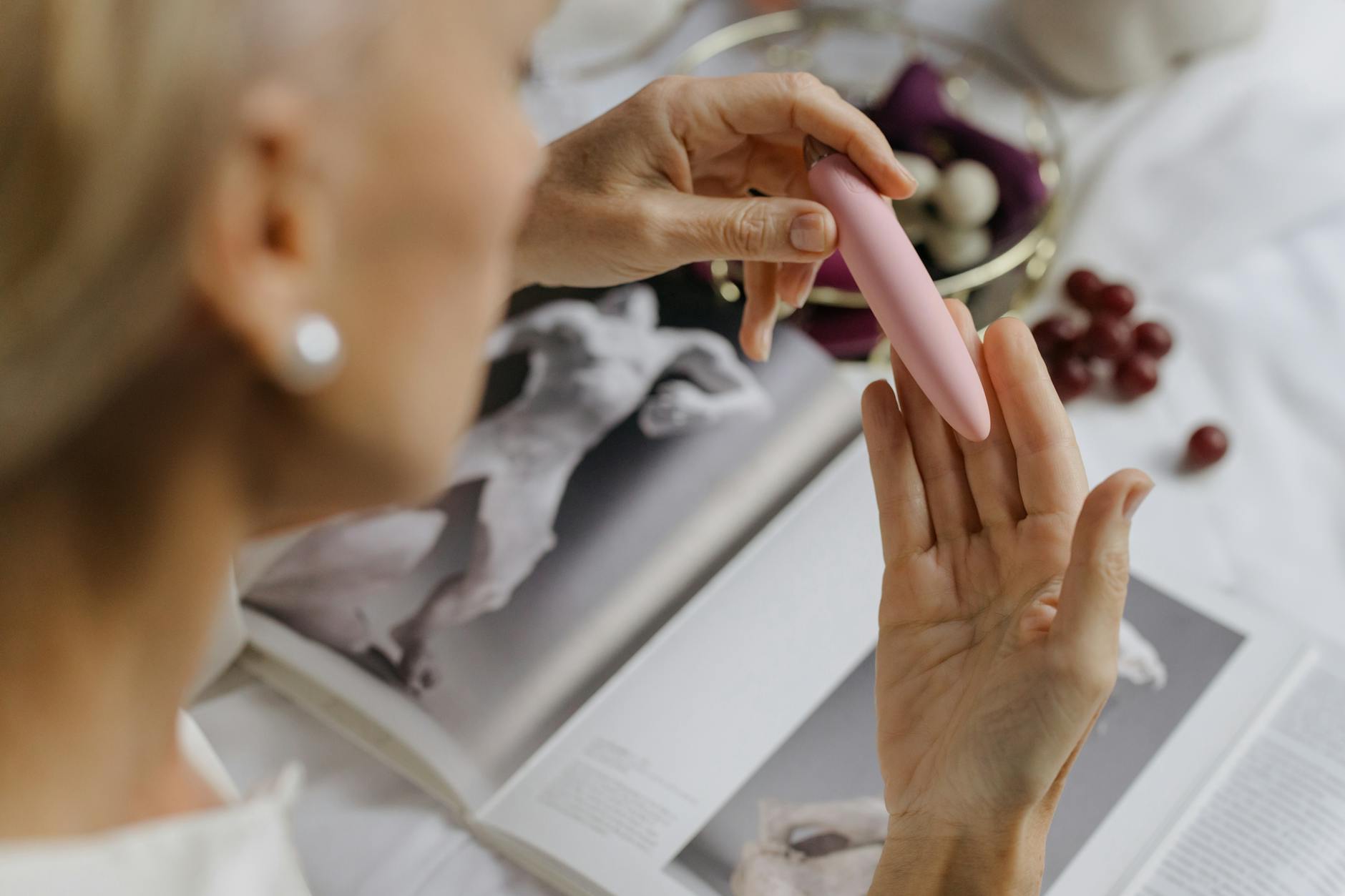
Photo by cottonbro studio on Pexels
The compromise that actually works
Here's what I've seen couples do well: start small, and keep the toy in the realm of shared pleasure, not solo pleasure. If your partner is nervous about toys in general, introducing one in the context of something you're doing together feels very different than you disappearing alone with it.
That might look like: "I want to try using a vibrator while we're together. I want you to be part of it. You're not using it on yourself. You're using it on me, or we're exploring it together." That shift removes the feeling of replacement and makes it collaborative.
You could start without penetration. Clitoral vibrators like a Lem are designed for external stimulation, which means they're less likely to feel invasive to the hesitant partner. It's also less of a leap into unfamiliar territory.
You could also set boundaries that reassure the hesitant partner. "I'm using this only when we're together," or "I want to use this maybe twice a month," or "I'm trying this for a week to see how I like it." Knowing there's a contained experiment, not an open-ended lifestyle shift, can help.
What to do if one of you really doesn't want this
Sometimes after an honest conversation, your partner still doesn't want to use a lemon vibrator during partnered sex. That's not the end of the conversation. It's the beginning of a different one.
You get to decide if solo pleasure with a vibrator is something you want, and your partner gets to have feelings about that. Both things can be true. You can love your partner and still want to explore your own pleasure independently. You can also respect your partner's feelings and agree to do it differently.
The mistake couples make is holding both needs hostage. "If you won't use a vibrator with me, I'm using it alone," becomes punishment. "If you want to use toys alone, I can't stay in this relationship," becomes control. Neither moves you toward the actual problem.
The actual problem is usually: How do we each feel sexually satisfied in a way that doesn't require the other person to override their own boundaries? And sometimes that question takes time to answer.
I've worked with couples where the hesitant partner, after a few months, became curious. I've worked with couples where one partner uses a vibrator solo and the other partner never touches one, and they're both thriving. I've worked with couples where they found a completely different toy or approach that felt better to both of them. There's no one right answer.
The conversation framework that changes things
When you're stuck, this tends to help: pick a time that's not sexual. Not in bed, not in the moment, not when you're already frustrated.
Start with: "I've been thinking about [vibrator / pleasure / trying something new], and I want to understand what you actually feel about it."
Then listen without fixing. If they say, "I feel like it means I'm not enough," you don't jump to "That's not true." You say: "Tell me more about that. When did you start feeling that way?"
Then share your side. Not to convince them, but to be known. "For me, it's not about you being enough. It's about me getting to feel really good, and I actually want you involved in that."
Then get specific about what you want to try, when, and how. Not "We should use vibrators," but "I'd like to try this once together next month, with you guiding it, and see how it feels."
Then listen again.
When pleasure preferences shift over time
Something I tell couples regularly: what one partner wants changes. Maybe right now, the vibrator feels like too much. In a year, something shifts. Or the opposite. Your partner loves it now, and later wants to return to toys-free sex. This is all normal.
That's why the conversation isn't one conversation. It's an ongoing check-in. "How are you feeling about using toys together these days?" "Has anything changed for you?" These questions keep the door open instead of letting resentment build under silence.
If you're reconnecting after extended time apart, preferences might shift. If one of you is dealing with hormonal changes affecting arousal, the vibrator might suddenly feel essential or suddenly feel unwelcome. Life changes what you both need.
The actual tool: how to use a lemon vibrator together when preferences differ
If you do move forward with trying a lemon clitoral vibrator, here's what I recommend:
Start with the hesitant partner in control. Let them hold it, turn it on, experiment with it on your body at their own pace. This reverses the power dynamic and makes them active rather than passive.
Begin at the lowest setting. You're not trying to achieve an orgasm. You're just gathering information about what it feels like.
Talk while it's happening. "That feels nice." "Can you go a little slower?" "I like this pattern." Your partner hears in real time that it's about pleasure, not performance.
Keep lube nearby. Water-based, if they're worried about mess. It makes everything feel better and gives you both something to do with your hands.
Set a time limit. "Let's try this for five minutes," not "Let's see where this goes." Contained experiments feel safer.
Afterward, check in. Not "Wasn't that amazing?" but "What was that like for you?" Let them have a genuine reaction, even if it's lukewarm.
People also ask
What if my partner thinks vibrators are weird or unnatural?
That belief usually comes from somewhere. A message they got growing up, a partner they had before, something they saw or read. It's worth asking where it comes from, not to argue with it, but to understand it. Often, once someone knows why they believe something, they're more willing to question it. You could also reframe it: "Bodies are weird. Pleasure is weird. That's part of why it's fun."
Can using a lemon vibrator actually help when we have different sex drives?
It can help, but it's not a cure. If one partner has significantly lower desire, a vibrator might make solo pleasure easier, which takes pressure off the higher-desire partner. But it won't magically sync your sex drives. What it can do is create a third option: you use a vibrator together, which might feel different and less demanding than partnered sex. Sometimes that opens a door.
My partner says they feel replaced when I want to use a toy. How do I address this?
Don't dismiss it. Sit with it. Ask what "replaced" means to them specifically. Is it about you finding pleasure they can't give you? About you wanting something they think they should be providing? About fear that you'll prefer the toy to them? Once you know the real fear, you can address it directly. Often, reassurance plus showing them the toy is about addition, not replacement, helps.
Is it normal to have one partner who loves vibrators and one who doesn't?
Completely normal. Bodies respond differently. Nervous systems are different. One person might find vibration grounding and the other overstimulating. One might love the idea and the other neutral. Neither is wrong. The key is finding what actually works for both of you, which sometimes means compromise and sometimes means doing different things.
What if we try a lemon vibrator together and one of us hates it?
That's data, not failure. You now know something. Maybe vibration isn't the thing. Maybe the timing was off. Maybe the partner who was hesitant needs more time. Maybe the partner who wanted to try realizes it feels different than expected. Take what you learned and decide what's next. It might be trying a different toy. It might be waiting six months and trying again. It might be accepting that vibrators aren't your couple's thing and that's fine.
How do I know if my partner is just afraid versus genuinely not interested?
There's a real difference. Fear often comes with a lot of words, explanations, reasons. "I don't know, I'm just not into it." Genuine disinterest is often quieter. You can tell by asking: "If there was nothing to be scared of, would you want to try this?" If they still say no, respect that. If they hesitate or say maybe, you've found the actual barrier, and that's something you can work with.
Your pleasure matters. Your partner's comfort matters. These things can coexist. It just takes honest conversation and the willingness to get curious instead of stuck. That's how couples actually move forward together.
Ready to have a conversation about pleasure preferences? I'm here to help at /contact.